
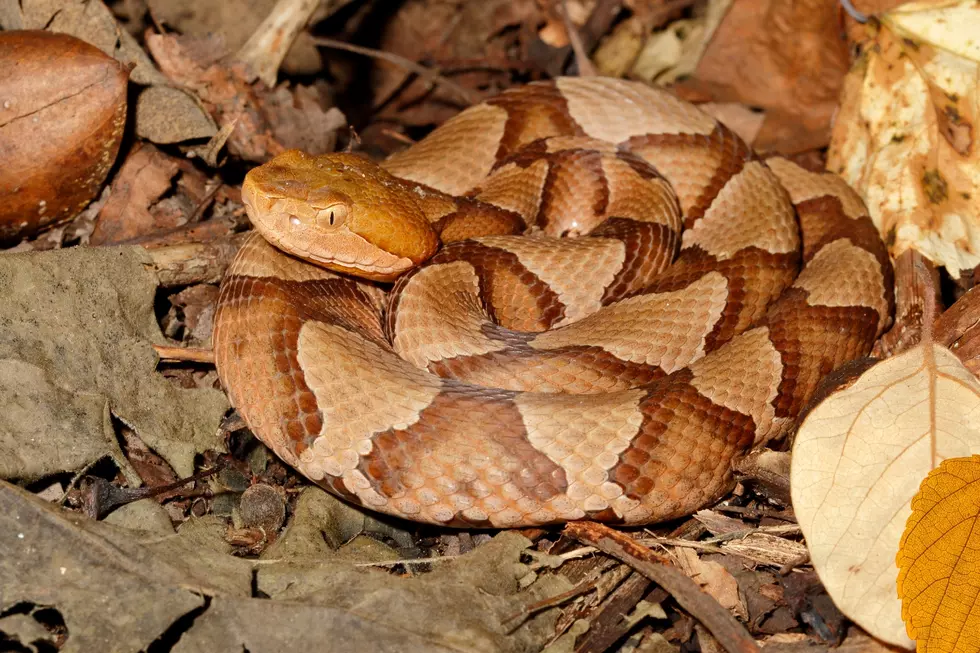
Copperhead Sighting in Alabama: Here’s What to Know
The word “snakes” alone makes me shiver. The closest snake I have ever encountered was in my dreams, or the garden snake that showed up while my mother was raking some leaves. What I didn’t realize was that my mother had her own little surprise! Let’s say that snake met its maker that day.
Now, before you roast my mother for killing a “good” snake, give her some grace. She didn’t know whether it was venomous, and I’m sure she wasn’t about to take the time to figure it out with a kid and a dog acting like savages nearby. All I know is that rake became a sledgehammer in five seconds flat.

My friend called over the weekend to report that she found a Copperhead snake in her backyard.
Me: A COPPERHEAD?
She said she panicked, hurried back inside, and watched from her kitchen window as the snake slithered across the yard; she believes it eventually made it past the back fence. She thinks this is a rare occurrence in her backyard.
ME: I THINK NOT, MA’AM
Naturally, I had to investigate, and it started with Outdoor Alabama. Copperheads are “Common statewide. Most frequently encountered venomous snake in Alabama.” The rest of what I found is scary to me. “Copperheads are found in greatest numbers in forested areas that have numerous rocky bluffs and ravines.” Also, ‘Copperheads can also be found along streams, hedge rows, and areas overgrown with kudzu.”
Discovery Moment: Behind her fence is kudzu.
I called her back and told her she needed to get rid of the overgrowth behind her fence. Then I asked, “Are you sure it was a Copperhead?” I asked because she was vouching to the heavens that she'd never set foot in her backyard again. She said, “I’m pretty sure.” I quickly asked What did it look like? She said, Google said it was a Copperhead. So, we will go with Google.
If you need to know, a Copperhead snake can range from “light brown to tan or pinkish in the southern copperhead. The northern copperhead usually has a darker and more reddish-brown body color,” said Outdoor Alabama. Other descriptions include a dark hourglass crossband and a tiny hole between the eye and nostril.
Another interesting fact about copperheads is that the snakes typically mate in both spring and fall. Their activity also depends on the weather. Outdoor Alabama said that “Copperheads remain active during the day when daylight temperatures are warm (spring and fall). However, during hot weather they are usually nocturnal (active at night).”
Good News About Copperheads [I Guess]
“Copperheads are not known as being an aggressive snake, said Outdoor Alabama. “They seldom strike unless stepped on or handled. Copperhead venom attacks the muscle and blood systems. Of all known venomous snakes in the United States, copperheads have the least toxic venom. Bites are painful but rarely fatal.”
The word “RARELY” doesn't comfort me.
More Things to Worry About
My investigation led me to the Alabama Cooperative Extension System of Alabama A&M University and Auburn University.
- Approximately 40 different species of snakes live in Alabama.
- Six of those 40 are venomous, including the copperhead, cottonmouth, pygmy rattlesnake, timber rattlesnake, Eastern diamondback rattlesnake, and coral snake.
- The diamondback rattlesnake and coral snake are primarily found in southern Alabama, and the coral snake is rare. Despite the rarity, the coral snake is considered Alabama’s most venomous snake.
- Late summer/early fall is an active season for snakes. Because of the cooler temperatures, many snake species are more active during the day.
My Investigation Outcome
- My friend has been cleared of all charges of being dramatic.
- Snakes in general are a threat to our peace.
- Yard work? CANCELED until further notice.
- Call the landscaping company and report that you saw a Copperhead snake in the yard; they should be on alert.
- Patio parties will continue, but only after the area passes a full security inspection.
LOOK: 20 of the biggest insects in the world
Gallery Credit: Andrea Vale
Quiz: Do you know your state insect?
Gallery Credit: Andrew Vale